Saturday, 28 November 2009

Respect

Sorry I've been off-line for a bit but I wanted to share with you (to use a ghastly expresion used by the cumbersomely titled "Director of Business Relations and Client ... something ..." I think I've got that wrong. Maybe it was "Director of Client Management and Business ... Whatever. Who cares. It was someone at the office I used to work in. Let's start again.

I'm going to upload this photograph. (Ooh, and at the risk of digressing again, how crap is Internet Explorer these days? I've had to log out of IE and go to Firefox to do the upload, Tchoh!)

I snapped this this afternoon and what you're looking at is Jose Agusto working on his chimney stack with the aid of some very rudimentary scaffolding consisting of a couple of tree trunks and a step ladder. He explained that he needed to heighten his chimney to stop the smoke blowing back down into the house.

It made me think that awful soft handed northern European townies like us would probably suffer in silence at the smoke in the house or else phone the council or Google who we could sue about it. But not Jose Agusto - he cuts down a couple of trees, commandeers a step ladder and hoys some breeze blocks aloft and sets about rebuilding his chimney. And if it doesn't work, then he'll go up and try something else.

Respect.

I don't normally mention my neighbours by name but I make an exception for Jose Agusto as he's a very nice man who's one of these guys for whom nothing is too much trouble when it comes to helping out neighbours - a true gentleman in every sense of the word.

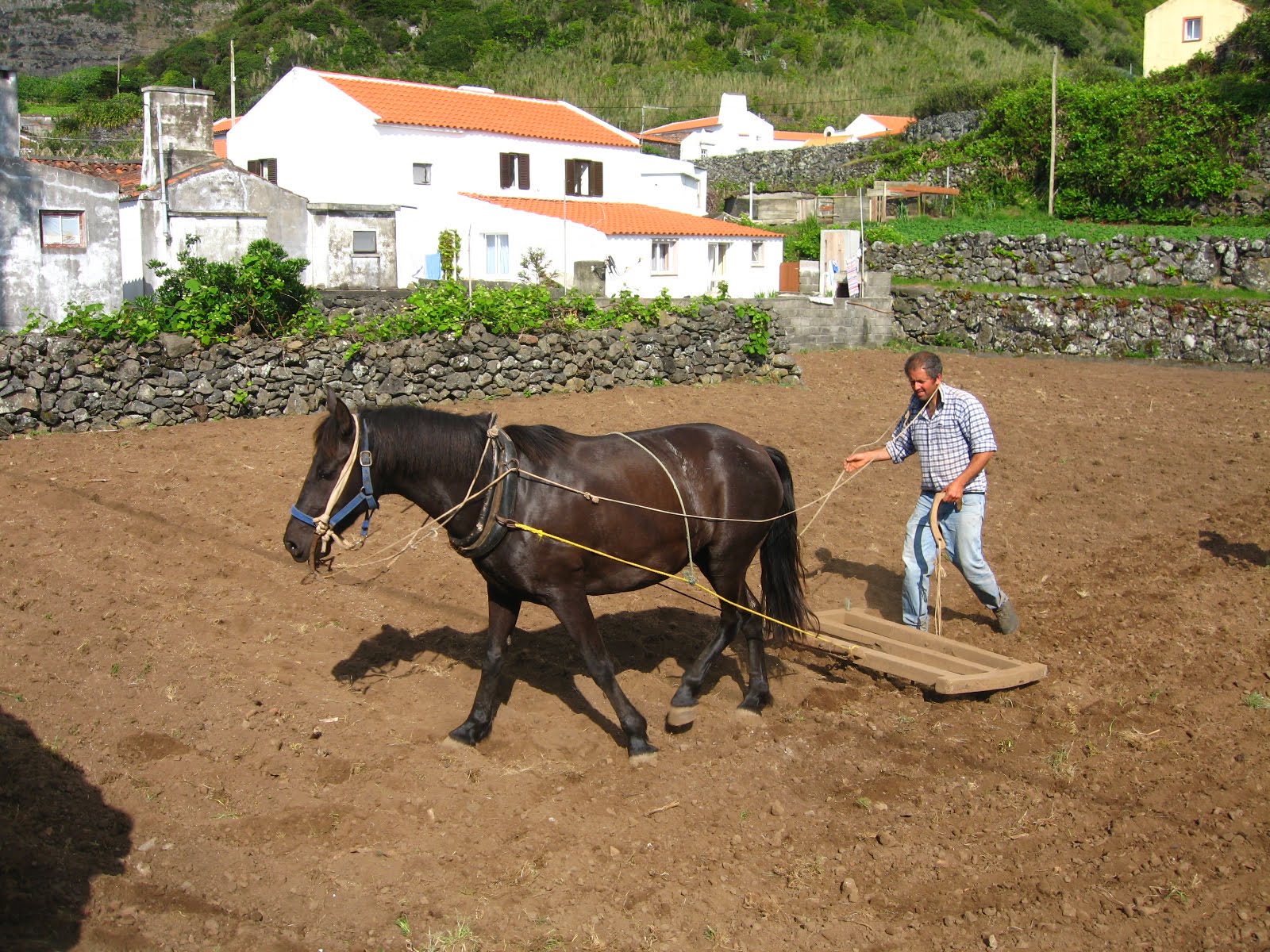
This is him ploughing a field opposite the house seen above. The horse is not for the tourists or some kind of retro-affectation. It's because he knows that ploughing a field as small as this is more practical with a horse than with the tractor so many of his neighbours have adopted.

I'd originally planned to write a blog entry about the interaction of researching the udal law of the seabed in Orkney with biscuits and cheese and tomateiro chutney of which I'd taken a photograph. But while downloading that photo, I came across the one of JA's chimney which I realised was a far better blog topic. But for the sake of completeness (as we lawyers say) here's the udal cheese pic (although the cheese has been eaten leaving just a chutney smudge).

It's a funny old life on Flores. But a good one.

Friday, 20 November 2009

Corvo

Flores has a little satellite island called Corvo about 10 miles to the north.

Despite having a population of 400, it's not an easy place to get to. Where I come from, an island of 400 people would get four calls a week from a 4,000 ton car ferry. But Corvo is visited only two days a week by a ferry from Flores with space for only 12 passengers (no cars). Its main link to the outside world is the aeroplane four times a week to Faial: some of these flights call at Flores en route but they don't permit a day trip.

In September, we tried to go for the day on the passenger ferry. We started in the Posto de Turismo to enquire about the timetable for the following day and where to buy tickets. We were directed to the Rede Integrado de Apoio ao Cidadao (Portuguese equivalent of the CAB but without the stigma). Their timetable was totally different from the PdT's but we would not be able to buy tickets for tomorrow because we didn't have our passports. (Why? Is Corvo execpted from the Schengen treaty or something?) In any case, all sailings were subject to estado do mar - sea conditions - which surprised me a bit as I'd read in the local press that the Portuguese tax payer had shelled out a six figure sum for an all-weather vessel. Was there a phone number to find out if the boat was sailing to save us driving over from Faja Grande only to discover it wasn't going? No, there isn't. So, the next day, we drove over, passports in hand, sandwiches buttered, and were told the boat would not be sailing por causa do estado do mar. No, there was no way of finding out when the boat might next sail. It was all very dispiriting and almost calculated to make you never want to attempt to go to Corvo ever again.

So it was with no intention of imagining we might actually go there that we found ourselves at Lajes harbour the other week watching the Corvo supply boat (not the ferry) loading up with everything from petrol to white wine. The skipper was keen to let me come aboard for a better picture:-


Purely out of curiosity, I asked when they'd be sailing - "Tomorrow at 9am, do you want to come?" was the answer. No passport required. Not even a fare to pay.

The following morning, the good ship Santa Iria was off at 9.15am - very punctual by Portuguese standards. We were the only two passengers on what was, after all, not a passenger sailing. The only "passenger accommodation" was a bench of three seats on the poop deck although the crew made it clear we were welcome to join them in the wheelhouse if it got too cold outside.

As it happened, it was fair all the way although the ship rolled a bit in the heavy seas and you really had to hang on. The Santa Iria, not exactly being a greyhound of seas, took 2.25 hours to get to Corvo. On arrival, the skipper told us it would take 1.5 hours to unload the cargo so that gave us time to wander round the only settlement on Corvo, Vila Nova do Corvo:-

Where I come from, Vila Nova do Corvo would be a "Conservation Village" where the cheapest property would be six figures (with the first one not being a 1 or a 2) and resident artists would fight retired lawyers for places on the community council and unanimously object to every planning application. But I don't think they have planning applications in VNdC never mind objections to them. It reminded me of one of those fishing (conservation) villages on the coast of Yorkshire like Staithes or Runswick Bay except a bit more "lived in".

There was also time to visit Corvo's "must see" - well, let's face it, Corvo's "only see" - the caldeira, the volcanic crater. That's not fair to call it the "only see" as just being on Corvo at all is a very interesting experience. But as this post is getting overlong, I'll talk about the crater next time.

Friday, 6 November 2009

Salmoura

You know how an Indian Summer is when you get a nice patch of summer weather in mid/late October? What's the winter equivalent of that called when you get a spell of prematurely bad weather around the same time? Whatever it is, we had one on Flores this year.

For almost two weeks in the second half of October, the rain poured and the wind blew but the thing is that, once the storm has blown itself out and the rain stops, there's still a massive swell coming in from the sea which breaks on the rocky shore and casts up a salt spray which just hangs in the air and drifts slowly inland: it's called salmoura in Portuguese.

If I were a poet, I'd be able to describe this hauntingly and beautifully in a poem. But I'm not so I'm going to show you in photographs instead. And as I'm a pretty indifferent photographer, you're going to have to use quite a lot of imagination to conjure up salmoura.

The thing about salmoura is that it doesn't half bugger up plants, many of which are still flowering merrily away around the end of October in this mild climate. As witness this clump of cubres:-

Observe how the seaward (left) half has been blasted by the salt spray while the landward half is still hanging in there. (Note to self to put windward pelargoniums in greenhouse. If not too late. Just one thing after another on this island.)

Wednesday, 28 October 2009

Kroten Wanderung

I don't know if any German speakers read this, but, in case they do, can I draw to your attention the following shortly to be published crime thriller:-


The reason I'm mentioning this is that Kroten Wanderung was written right here in Faja Grande. Indeed, Rainer did a bit of research for it from our computer (there being no Wi-Fi in FG). So if it becomes a best seller, we'll get one of these plaques on the front of our house saying "In this house ...". (When we used to live in Edinburgh, about three doors up the road was a plaque saying this was the house the Icelandic national anthem was written in - I'm not joking. So by that measure, if Kroten Wanderung sells more than about 10 copies, we're definitely in line for a plaque.)

Kroten Wanderung is German for "toad migration". Except kroten is also German slang for money so it becomes "money migration" = money moving around = corruption. It's an idiom which doesn't really work in English so before we get that plaque, we're going to have to think of a better name for the English translation (not planned at present).

Nice bloke, Rainer. Only German I've ever met with a viable sense of humour - very good gag about lifejackets on Filipino boats. When he's not writing crime novels, he's a travel writer. Last week he was in Curacao and as I write this he's in Zanzibar. Bastard.

Thursday, 22 October 2009

Google Earth

It's not all planting orange trees and picking grapes out here, you know!

Time has to be found to Google Earth the nearest villages to Faja Grande in Europe (bar Madeira and the Canaries) and North America - a dirty job someone has to do considering FG flatters itself as the west-most village in Europe (if you don't count anywhere in Greenland or the French departements outre mer - Guadeloupe and Martinique - in the Caribbean).

Anyway, at No. 1, the nearest mainland settlement to here is a place called Peniche on the west coast of Portugal about 40 miles (65km) north of Lisbon. It's 1,160 miles (1,870km) from Flores.

At No. 2, only 40 miles further from here than Peniche in the other direction, is a village rejoicing under the name of Renews-Cappahayden in Newfoundland, Canada, 1,200 miles (1,930km) away. It reminds me a lot of Lochmaddy in North Uist in the Outer Hebrides of Scotland:-

But Newfoundland is an island so, at No. 3, the nearest village on the continent of North America, 1,465 miles (2,360km) away, is St. Lewis (previously known as Fox Harbour) in Labrador, Canada and officially recognised as the eastmost permanent settlement in mainland America.

Nearest points in:-

* the British Isles - Skellig Michael, an island off the SW coast of Ireland - 1,310 miles (2,110km) - further away than Newfoundland.

* the UK - the Isles of Scilly off the west coast of Cornwall, England - 1,410 miles (2,270km) - closer than Labrador.

* Scotland - the Mull of Kintyre (as in Paul McCartney) - 1,600 miles (2,580km) - a stone's throw from Campbeltown.

You're mocking now but you'll thank me next time you're attempting to break a ballooning record and you look round and find Richard Branson slumped over the controls.

Tuesday, 20 October 2009

Cubres

What connects fictional troubled Mafia boss Tony Soprano with the island of Flores?

The answer is flowers - specifically seaside goldenrod (solidigo sempervirens). In the last scene of episode 6 of the second series, Tony is holding a bunch of flowers which includes seaside goldenrod.

Sorry for the poor quality of that picture but I don't know any cleverer way of doing it other than taking a photo of the TV. The seaside goldenrods are the small yellow ones - the uppermost in the bouquet above the yellow daisy and to the left of the upper red rose Tony's got his hooter in.

Known as cubres in Portuguese, seaside goldenrod is native to the Azores and is said to be the flower the abundance of which on Flores led early travellers here to christen the island "Flowers" - although how anyone knows that in the absence of a watercolour undeniably of a cubres in bloom endorsed in a late 15th century hand with "This is the plant the abundance of which led us to christen the island two day's sailing west of Faial Flores - (Signed) C. Columbus", I do not know.

Anyway, here's a clump of cubres at the carpark at the balneário (swimming area) in Fajã Grande this afternoon.

Sunday, 18 October 2009

Cumbernauld Pie

You'd think that living on this verdant island in the middle of the ocean, we'd spend our time dining off the freshest of fish and vegetables but, au contraire, we prefer Cumbernauld Pie.


Back in the 70s, some marketing genius (probably employed by Marks & Sparks) invented the Cumberland Pie. An extension of the successful Shepherd's Pie and Cottage Pie franchise, it's basically mince and potatoes except you mash the potatoes and put them on top of the mince and serve it in a pie dish.

Cumberland is a very picturesque district of north west England (it's where the Lake District is), replete with shepherds and, indeed, cottages so, all in all, it was the logical next step in pie branding.

Which is why in King-Duncan iconography, the Cumberland Pie is always referred to as the Cumbernauld Pie. Cumbernauld is a 60s "New Town" in Scotland, built full of hope for a new generation but which quickly degenerated into one of the most blighted places on the face of this planet. Carol worked there as a lawyer in the 90s when she defended people against sex crimes too unwholesome to mention and represented divorcing couples in which the upbringing of the children was a secondary consideration to custody of the Elvis Mirror (you think I'm joking?)

Anyway, how did I get on to this? Oh yes, pies. Carol was telling me that the secret of a good Cumbernauld Pie topping was to "fold some cheese in to the potato". Which I have to say set my teeth on edge in rather the same way as when sperm donation is mentioned at the dinner table.

"Folding in" is not unakin to "grilling off" - it's like the bit in Blackadder when he says "Don't say "tush", Percy - it's only a short step from "tush" to "hey nonny-nonny" and then I shall have to call the police."

To my mind "grilling off" is a short step from saying "through Friday" when the speaker means until Friday. That ghastly Americanism which implies passing through Friday to Saturday (or even Sunday or Monday for aught anyone knows) has even begun to appear on the BBC, the organisation which until quite recently was still holding the line on "disinterested".

I seem to have just inadvertently covered "Things that make me cross" #2 through #4 ...